

Knee Pain While Climbing Stairs ? Here’s What It Could Mean
Introduction
If walking on a normal surface feels fine but your knee starts hurting when you start climbing stairs, you might be wondering what’s going on.
Here’s what most people don’t realize: your knees handle up to 5–6 times your body weight when you climb stairs. That means even a small underlying issue can turn into noticeable pain under added load.
That additional strain should be harmless, but if you’ve been taking the stairs a lot, maybe have an existing health condition, or even just twist incorrectly, you may find going upstairs is unexpectedly painful.
Today, in this article, we will explore why knee pain occurs, how to treat it, and when it is necessary to consult a knee replacement surgeon.
Why Knee Pain Happens While Climbing Stairs`
While climbing stairs, the knee is highly flexed under load, which puts the joint, cartilage, tendons, and muscles surrounding the joint under a lot of stress compared to walking on flat terrain.
This is what is going on in your knee when you climb:
- The patella (kneecap) is gliding on a groove on the femur. In case such movement is limited or imbalanced, pain arises in front of the knee.
- The cartilage around the joint is impact-absorbing. Bone starts grinding bone as it wears away, causing sharp or deep aching pains.
- Your thigh muscles (the quadriceps muscles) have to work harder to help you climb the stairs, using the front muscles. When they are weak, the knee becomes overstressed.
- Inflammatory tissue within the joint causes the bending movement to be painful, particularly during load-bearing.
This is the reason why stair-climbing pain frequently is an initial or worsening symptom of multiple underlying knee disorders.
Common Causes of Knee Pain
1. Osteoarthritis
Knee pain due to osteoarthritis typically occurs in people aged 45 or older. This is because of the gradual degradation of the crude material in the knee joint.
The ludicrous distance between bones is diminished when the cartilage breaks down, causing incorrect movement and pain. Initially, the patient carries a painful deep pain, which is worse by walking, like ascending stairs, and relieved by rest.
2. Ligament Issues
The knee is supported and balanced by four main ligaments. Sports injury, accidents, or simple accidental twists usually result in torn ACL (anterior cruciate ligament) and MCL (medial collateral ligament).
If a ligament ruptures, say, a hundredth of a millimetre down the middle, and the third of the knee opens and will relax just like this [movement] in an old tennis ball centred with your thumb — but not function properly — it will provide you with various sensations from unsteadiness to pain because taking stairs feels alien.
3. Cartilage Damage (Meniscal Tears)
An AC-shaped cartilage pad in your knee provides weight-bearing and shock-absorbing function. Tears or sports-related injuries can cause pain, swelling, and even locking in the joint.
Descending stairs is a very painful experience when one has a meniscal injury since the knee will have to support the weight of the body and bend forward at a very deep level.
4. Muscle Weakness
This is a significant aspect that is mostly ignored. Incomplete quadriceps and hip muscles cause the knee to compensate in motions. This gradually overworks the joint and develops patterns of pain, particularly on stairs.
The other common cause of patellofemoral pain syndrome is muscle imbalance, in which the kneecap fails to follow the correct path.
5. Previous Injuries
Injuries that were not rehabilitated due to a lack of attention or treatment will tend to recur in the form of chronic pain in old age.
A past fracture, tear of the ligament, or damage to the cartilage may cause premature wear of the joints, and this can lead to the development of arthritis earlier than expected.
Early Warning Signs You Should Not Ignore
Knee problems rarely appear overnight. There are usually early signals that something is off. Watch out for:
- Pain in particular, up or down the stairs, although it may vanish afterwards.
- Morning stiffness lasts over 30 minutes to relieve.
- Swelling around the knee after physical activity or at the end of the day
- Click, grinding, or popping when moving (bending the knee in particular)
- Feeling of the knee “giving way” or feeling unstable
- Difficulty straightening the knee fully
When you find one or more of these habits, you will want to have a proper examination. Early diagnosis nearly always results in improved outcomes and, in most instances, would avoid surgery.
Read our latest guide on Dr. Aditya Vasudev, the top orthopedic surgeon in Kolkata.
When Should You See an Orthopedic Doctor ?
Not every twinge requires a doctor visit, but there are clear situations where you should not delay. See an orthopedic doctor in Salt Lake if:
- The pain has lasted more than two to three weeks without improvement
- You are modifying your daily routine to avoid the pain (skipping stairs, avoiding walks)
- The pain wakes you up at night or is present even at rest
- There is visible swelling, redness, or warmth around the knee
- You have had a fall or injury that triggered the pain suddenly
- Over-the-counter pain medication is no longer effective
There are many qualified orthopedic surgeons available for patients. An early consultation, with an X-ray or MRI as necessary, will provide your definite diagnosis and a plan of treatment. Delay may enable the underlying condition to advance and restrict your treatment choices.
Non-Surgical Treatment Options
The good news is that most knee pain can be treated non-operatively. According to how serious the diagnosis is, one or more of the following may be advised by your orthopedic physician:
Physiotherapy
Customized physiotherapy aimed at dispersing surrounding knee muscle tension, joint range of motion, and movement pattern modification.
In fact, you likely know it as the first line of treatment for joint pain, mild arthritis, and ligament sprains.
Medications
Painkillers, non-steroidal anti-inflammatory drugs (NSAIDs), or topical gel can be used to help manage the pain and swelling. In other cases, corticosteroid / hyaluronic acid joint injection can relieve symptoms and postpone surgery.
Lifestyle Modifications
Mundane adjustments can make a difference. An ideal weight can help produce a significant decrease in the load to the knee joint.
However, the damage to the joints can be too serious in order to be alleviated with the assistance of conservative management in certain situations.
Exercise and Strengthening
There are specific exercises, in particular of the quadriceps, hamstrings, and gluteal area, that help stabilize and offload the knee.
They are relatively long-lasting methods of sustainable management of joint pain and can be performed at home on the advice of a Physiotherapist.
When Knee Replacement Becomes Necessary
For many patients, non-surgical treatment works well for years.
However, the joint damage in certain instances might be too severe to be alleviated through the assistance of conservative management.
- Knee replacement surgery, or total knee arthroplasty, is an alternative when: Arthritis is known to severely damage cartilage, and the joint space is significantly reduced.
- The pain is chronic and present even when the person is resting and hugely affects the quality of life.
- Simple activities like walking short distances, getting out of a chair,r or sleeping have been difficult.
- Tried for several months without sufficient relief. Non-surgical treatments have been tried without sufficient relief.
- X-rays or imaging: advanced degeneration of the joints.
In the case of most patients, the non-surgical treatment is effective for a number of years. However, sometimes the damage to the joint may be so severe that conservative management can do little to help provide relief.
The choice of whether or not to undergo surgery will always be a joint effort between you and your physician, depending on your symptoms, imaging, age, level of activity, and general health.
During consultation, all these factors will be taken into account by a qualified knee replacement surgeon in Kolkata who will then advise surgery.
Simple Tips to Manage Knee Pain Daily
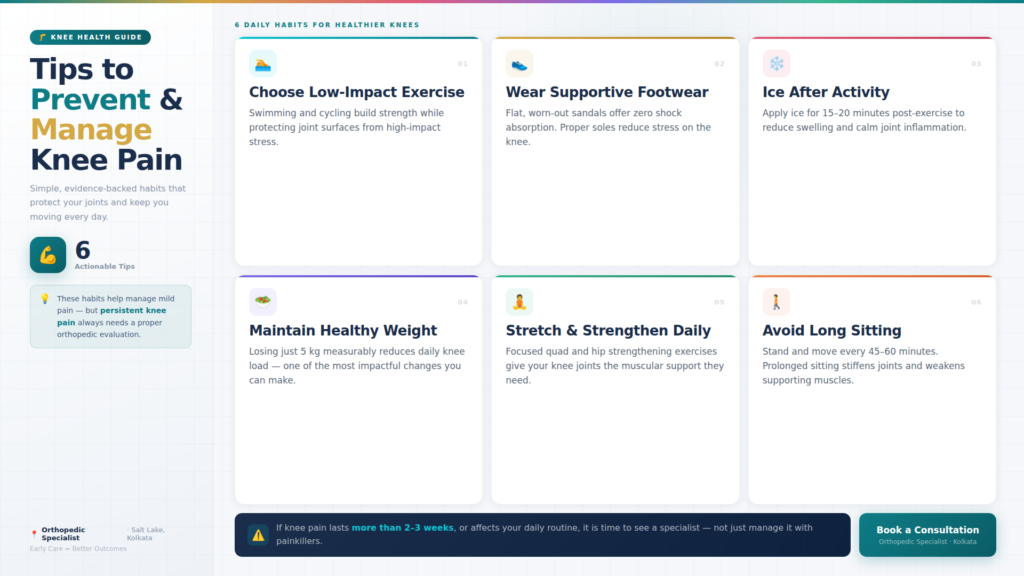
Any of these can be used to alleviate discomfort during your waiting time to have an appointment or as part of your continuous management:
- Ice packs 15-20 minutes after activity to reduce swelling.
- Use the railing and one stair at a time, and take the stairs slowly when you are having any symptoms.
- Do not sit with your knees bent for a long time; take a short rest between to stretch the legs and move them.
- Wear good-cushion supportive shoes/sneakers; do not wear flat slippers when walking long distances.
- Sleep with a pillow under your knee in case you have pain at night.
- Do the range-of-motions exercises softly in the morning to reduce stiffness before getting up.
- Be of normal weight; even loss of body weight can significantly reduce the load on the knee joint.
- Never squat or sit cross-legged on the floor when in the acute stage of the pain.
Read our article: India Orthopedic Implant Market Report (2026 Edition)
Conclusion: Do Not Let Knee Pain Slow You Down
Contemporary knee replacement surgery is very successful. The majority of patients experience significant pain relief, and within a few months, they resume normal life.
Knee pain while climbing stairs is more than just an inconvenience. It is commonly an early indication of an ailment in a joint that, if taken care of soon enough, can be successfully treated with the appropriate treatment.
The later you treat the condition, the further it can develop, and the fewer treatment alternatives you can have.
Consult with an experienced orthopedic surgeon and discuss your knee problem in detail.
Starting with specific physiotherapy to end-stage joint replacement procedures, Dr Aditya Vasudev’s orthopedic care provides a complete solution at all levels of the issue.
Book your consultation today and take the first step toward pain-free movement.